Platform Overview for Advertisers
Last updated: October 13, 2026
What this is
This article explains what Audyence is for advertisers: how your campaign reaches publishers, and how leads are checked and delivered to you.
Key takeaway: Audyence RTD is a B2B lead generation marketplace. You define what a qualified lead looks like, vetted publishers compete to deliver it, and every lead is checked against your requirements before it reaches your account.
Words to know
RFP: the campaign brief you send to publishers to ask for bids.
Proposal: a publisher's priced reply to your RFP.
Campaign Order: the commitment created for each publisher when you give them budget. It's similar to an insertion order.
What Audyence does for advertisers
You define what a qualified lead looks like:
target accounts
geography
industry
company size
job function and level
intent signals
the contact fields you need
You also set your budget and flight dates (the dates your campaign runs).
Audyence sends your campaign as an RFP to its network of vetted publishers. These publishers run digital magazines, industry journals, communities, newsletters, and other B2B content sites.
Publishers reply with priced proposals. You choose which publishers to work with and how much budget each one gets. Publishers then share your gated content with their audiences and generate leads. Audyence handles validation, enrichment, and delivery.
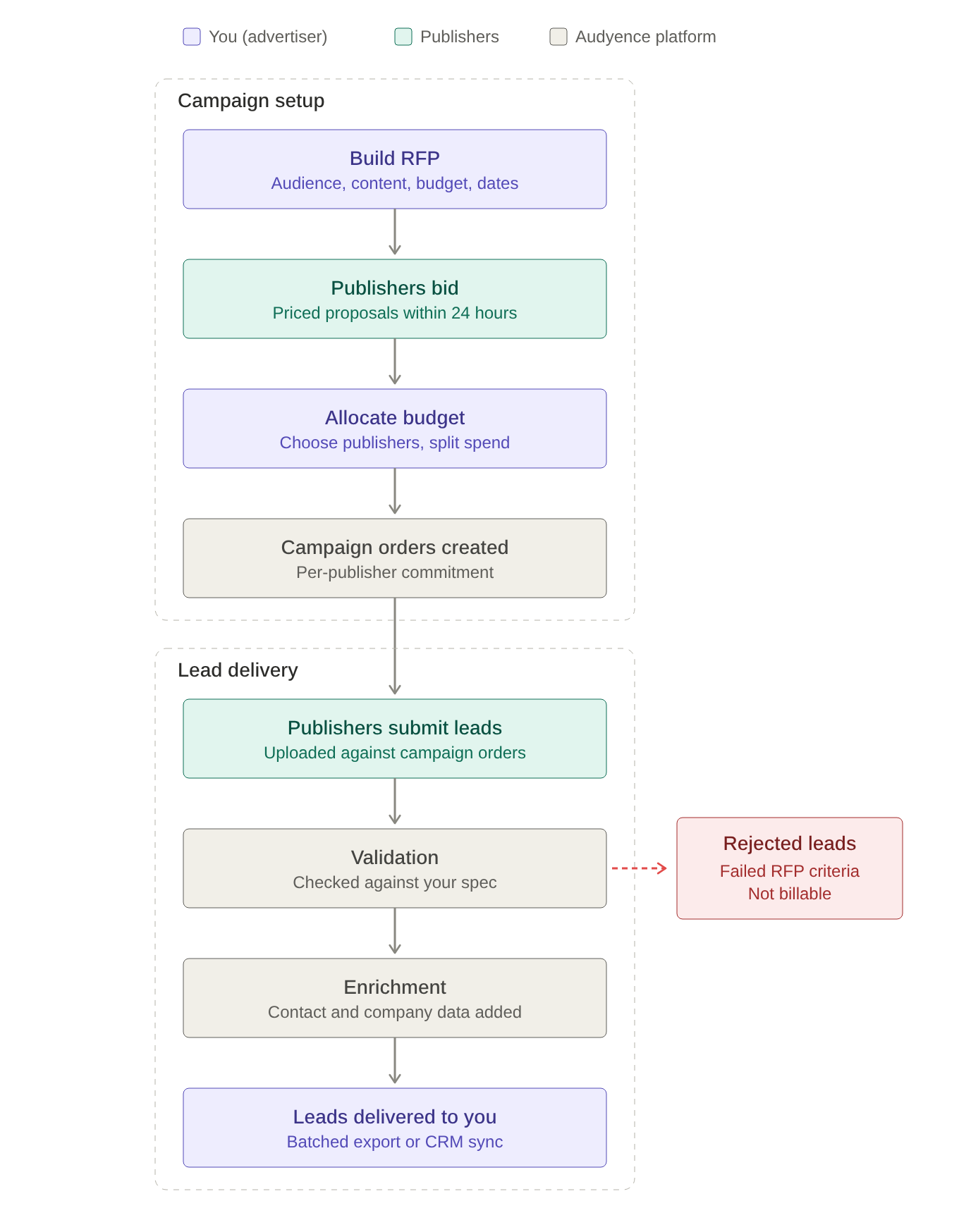
How campaigns reach publishers
You build an RFP. This is your campaign brief: your audience, form fields, content assets, budget, and flight dates.
Publishers bid. The RFP goes to the publishers you select. They reply within 24 hours with proposals that include their available lead volume, minimum budget, and dynamic pricing.
You allocate budget. Compare proposals side by side and decide how much budget each publisher gets. The platform works out each publisher's lead goal and effective price for you.
Campaign Orders are created. When you confirm your allocation, a Campaign Order is created for each publisher. It commits them to deliver against your brief, budget, and timeline.
Important: An RFP is not a commitment. No budget is committed until you allocate budget to proposals and Campaign Orders are created.
How leads are checked and delivered
A lead is a contact who meets all four of these:
Matches your campaign specifications (targeting, fields, allowed values).
Engaged with your content while your campaign was running.
Is verified as a real person at the company, with a working email address.
Opted in to be contacted.
What happens to each lead:
Publisher submission: publishers upload leads to the platform against their Campaign Order.
Validation: Audyence checks each lead against your campaign requirements: targeting criteria, required fields, and allowed values.
Enrichment: accepted leads can get extra contact and company data from Audyence's data partners.
Delivery: validated leads are delivered to your account in batches, based on the pacing you chose. You can export them or sync them automatically to your CRM or marketing automation platform through integrations.
Tip: You pay for delivered leads. Leads that fail validation are rejected and aren't billable.
Key terms
Show key terms
Term | What it means |
|---|---|
RFP | The campaign brief you send to publishers to ask for bids. |
Campaign Order | The commitment for each publisher, created when you allocate budget to a winning proposal. It's similar to an insertion order. |
Cost per Engagement (CPE) | The pricing model: you pay per engagement (see the note below). Prices are set dynamically by publisher proposals, so cost varies by allocation. |
Target Account List (TAL) | A list of companies you want leads from. Upload your own, or build one in the platform from company details and intent data. |
Intent data | Company-level buying signals (powered by Bombora Company Surge, refreshed weekly). They help you focus on companies that are actively researching your topic. |
Preferred Deals vs. Programmatic Guaranteed | The two buying models on the marketplace. See Preferred Deals. |
Important: Audyence prices per engagement (CPE), not per lead. An engagement is one time a lead engages with a piece of your gated content. A single-touch lead (one engagement) costs about one CPE. A multi-touch lead that needs three engagements costs about three times the CPE.